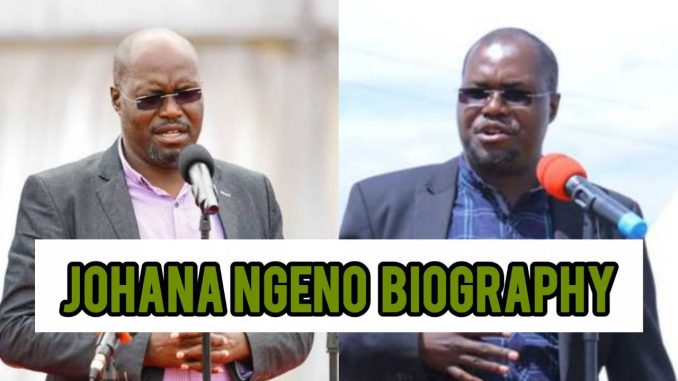
Johana Ngeno Biography
Johana Ngeno Kipyegon was born on December 12, 1972, in Narok County, Kenya. He came from a rural background and grew up in a community where farming, tradition, and local ties matter a great deal. From an early age he showed curiosity about the wider world and a desire to learn. He completed his primary education at Mogondo Primary School and then attended Maseno National School, where he finished his secondary studies. Later he went abroad to study and then returned to Kenya to continue higher education. Johana Ngeno was 53 years old as of 2026.
Education stayed important for him throughout his life. Johana earned a Bachelor of Arts in International Law at Kyiv TSN University in Ukraine, and then he returned to Kenya to continue his schooling. He earned a Master of Arts in International Studies from the University of Nairobi and a Bachelor of Laws degree from Mount Kenya University. He also completed postgraduate legal training at the Kenya School of Law.
After years of study and practice he reached a long-held goal: in September 2025 he was admitted to the bar as an Advocate of the High Court of Kenya. This formal legal qualification came late in his career but reflected a steady commitment to learning and to deepening his role as a legislator and public problem-solver.
From the start of his career he combined public administration, legal training, and grassroots engagement. Those varied skills helped him move from public service roles into elected office. People who knew him describe him as a leader who bridged rural concerns and national policy, someone who used formal training to serve people who had not always had a loud voice in national debates. His personal story — from Mogondo to Parliament and finally to legal admission — shows a path that mixed study, public work, and community commitment.
Johana Ngeno Career
Johana Ng’eno’s public career has two clear parts: public administration before elective office, and national legislative work after he won his first election. Before he entered Parliament, he served as a director at the Agricultural Development Corporation (ADC) from 2008 to 2012. That role placed him at the center of agricultural planning and support programs, and it gave him experience in managing institutions that aim to boost farming and rural incomes. His time at ADC built technical and managerial skills that later helped him run constituency projects and to push for development in Emurua Dikirr.
In March 2013 Johana first won election as Member of Parliament for Emurua Dikirr Constituency in Narok County. He won again in 2017 and again in 2022, serving three consecutive terms in the National Assembly. During his time in Parliament he served on important committees and became known for active constituency work. He chaired and served on panels tied to justice and legal affairs, public investments, and housing and public works, and he used his committee roles to press for services and infrastructure projects that his constituents needed. His re-elections showed that many voters felt he was present and responsive to local needs.
Johana earned a reputation as a grassroots lawmaker who mixed vocal advocacy with hands-on development projects. He worked to improve roads, to bring bursaries and school support, and to strengthen health and water services in his area. He also acted as an intermediary when local disputes arose, and he is credited in local reports with buying land to settle a long family dispute — a rare but meaningful example of using local resources to create peace. Inside Parliament he was active on committees and used law and study to shape his interventions. Even as he took on national duties, he often returned to community tasks and local problem solving.
His career also had public challenges. In 2020 he was arrested and charged in connection with remarks made during debates over forest eviction — an episode that led to legal action and public attention. Later, in early 2026, social media carried contested claims about a misuse of public funds involving a companion; these claims were made by a constituent and remained disputed online rather than settled in court.
Such controversies are part of the public record of many long-serving local politicians and they show that a public life often includes opposition and hard scrutiny, especially when land and resources are at stake. Despite these moments, his supporters said he remained focused on development work and on defending his people’s rights in national forums.
Johana Ngeno Personal Life
Johana Ngeno was married to Naiyanoi Ntutu. He is also survived by at least one daughter, Princess Taparon. People close to him remember him as a leader who put community and family first, even as he took on the pressures of national office. His marriage in 2021 was widely reported as a joyful personal milestone, and it drew interest because it came while he held public responsibilities. Friends and colleagues often described him as fearless and focused, someone who championed local artists as well as ordinary farmers and parents.
Outside politics, Johana cared about education and local culture. He used his platform to support schools, to fund bursaries that helped needy students, and to back local cultural events and artists. Those efforts were part of an effort to bring long-term social value back to his area, beyond short-term project headlines. In speeches and in local visits he spoke about justice, about fairness, and about making sure that national programs delivered to border and pastoral communities as much as they did to central towns. His mix of international study and local commitment made him a familiar presence in both high-level debates and roadside meetings in Emurua Dikirr.
Johana Ngeno Death
On February 28, 2026, Johana Ng’eno’s life ended suddenly when the helicopter he was traveling in crashed in Mosop, Nandi County. The aircraft went down near Chepkiep and burst into flames shortly after an attempted emergency landing during bad weather. Police confirmed that six people on board died in the crash; the victims included Johana Ng’eno and others who had been with him that day. The crash sparked immediate investigations by police and aviation authorities to find the cause and to prevent future tragedies. Initial public reports pointed to adverse weather as a likely factor, but investigators opened a full inquiry to examine technical and operational causes.
On the day of the accident Johana had been active in the field. Reports document that he visited flood-affected families near the Mara River and later took part in a cultural event that celebrated local artists. Witness accounts and media timelines describe a busy day of service and community attendance before the flight. The shock of such a sudden end — after a day spent helping people — produced a strong public reaction across political lines.
The President, the Speaker of the National Assembly, and many governors and MPs issued statements mourning his death and praising his service to the nation and to his home area. The deaths were described as a heavy loss for both Emurua Dikirr and for Kenya’s Parliament. Officials arranged coordinated support for his family and for funeral arrangements, as public leaders moved quickly to honor his memory.
The burning wreckage meant that the bodies were badly damaged and that recovery and identification efforts were painful for relatives and for responders. As investigators worked, Parliament observed formal tributes and set in motion plans to support the bereaved family and to fill the leadership gap for the constituency. The public reaction showed how a single day’s work for a local leader can end in sudden national sorrow, and how communities rally around grieving families while asking for full technical answers about what went wrong.
Conclusion
Johana Ng’eno’s life moved from rural Narok to the halls of Parliament, from early schooling in Mogondo to study abroad, and finally to formal admission to the bar in 2025. As a director at the Agricultural Development Corporation, then as an MP re-elected three times, and as a committed constituency leader, he combined local empathy with formal training. His sudden death in the Nandi helicopter crash on February 28, 2026 ended a career of active service and left many Kenyans mourning a leader who often spoke for the weak and under-served. In the weeks that follow, the nation will watch official investigations into the crash and remember both his community work and his commitment to public education, justice, and infrastructure.
FAQs
Who was Johana Ng’eno and how long did he serve as MP
Johana Ng’eno was the Member of Parliament for Emurua Dikirr in Narok County. He was first elected in March 2013 and was re-elected in 2017 and 2022, serving three consecutive terms until his death in 2026.
What was Johana Ng’eno’s educational background and was he a lawyer?
He completed primary and secondary school in Kenya, earned a Bachelor of Arts in International Law from Kyiv TSN University, a Master of Arts in International Studies from the University of Nairobi, and an LL.B from Mount Kenya University. He completed the postgraduate diploma at the Kenya School of Law and was admitted to the bar as an Advocate of the High Court in September 2025.
What role did he have before entering elective politics?
Before becoming an MP, Johana served as a director at the Agricultural Development Corporation from 2008 to 2012, where he worked on programs that support farming and rural development.
How did Johana Ng’eno die and where did the crash occur?
He died on February 28, 2026, when the helicopter he was traveling in crashed and caught fire near Chepkiep in Mosop Sub-County, Nandi County. Police said bad weather likely contributed to the crash and investigators opened an inquiry.

Leave a Reply