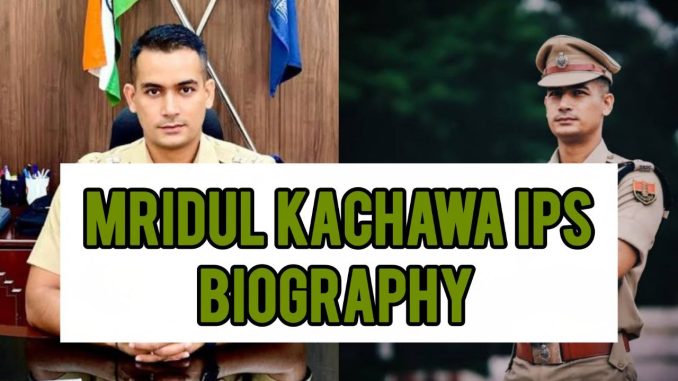
Mridul Kachawa IPS Biography
Mridul Kachawa was born on August 30, 1989 in Rajasthan, India. His early years were shaped by local schools, coaching and an interest in law and order that eventually led him to prepare for India’s civil services and the police service exam. Those formative years taught him discipline, patience and the value of steady study — qualities that matter when a young officer begins posting in towns, learns the ropes of district policing, and slowly takes on larger responsibilities. Mridul Kachawa IPS is 36 years old as of 2026.
Mridul Kachawa IPS Career
Kachawa’s professional path followed the standard IPS progression, with early postings that gave him direct exposure to district policing, investigations and community work. He learned to manage the day-to-day tasks of keeping public order, controlling traffic, supervising criminal investigations, and working with civic authorities on safety projects.
Over the years he moved through responsibilities that included supervising local police stations, overseeing crime prevention initiatives, and coordinating with other government departments for disaster response and festival security. He built a reputation for hands-on leadership at the district level and for steady administrative work when asked to handle postings requiring strict attention to rule of law and public access to services. Those skills made him a candidate for larger district commands when the state government planned a major reshuffle of senior officers.
Mridul Kachawa IPS Personal Life
Away from work, Kachawa keeps a modest life. He is private about his family and personal routines, preferring to let professional performance speak on his behalf. Colleagues say he balances the long hours of policing with simple domestic life, finds time for basic fitness and reading, and values the company of close friends and family when off duty.
Like many officers who come from service-oriented backgrounds, he takes time to mentor young subordinates and to advise junior officers on practical policing skills: how to write clear reports, how to plan a secure convoy, and how to engage a community in crime prevention without escalating tensions. His private approach helps him focus when public attention falls on the police during tense times.
Mridul Kachawa IPS Rajasthan Transfers
In a late-night administrative move, the state government executed a broad reshuffle affecting sixty-four Indian Police Service officers and reshaping leadership in the capital and many districts. The shuffle included significant changes inside the Jaipur police commissionerate and across district superintendencies, and it was intended to refresh leadership and respond to local political and law-and-order priorities.
The list of changes named several senior officers and new district postings: Ajay Singh was appointed Additional Commissioner of Police (Crime) in the commissionerate, replacing Manish Agarwal, who was moved to the intelligence wing at police headquarters. At the same time, Ranjita Sharma took over as DCP (East) while Prashant Kiran became DCP (West). The commissionerate’s crime and traffic desks also saw new faces with Hanuman Prasad Meena posted as DCP (Crime) and Nishchay Prasad M appointed DCP (Traffic).
Across districts the government reshuffled many SP postings: Narendra Singh was named SP Barmer, while the subject of this profile, after earlier postings, moved to lead the Bikaner district as SP. Other senior movements included Amrita Duhan to Udaipur, Roshan Meena to Nagaur and Harsh Vardhan Agarwala to Ajmer. Officers who changed districts in the same sweep included Sudheer Joshi, Yogesh Goyal, Narendra Singh Meena, Piyush Dixit, Pushpendra Singh Rathore and Kamal Shekhawat. Several other appointments were included, such as Avnish Kumar Sharma at Bundi and Brijesh Jyoti Upadhya moving to Bhiwadi.
The reshuffle also reflected political pressures and ongoing inquiries: for example, Mamta Gupta, who had earlier clashed with a local Member of Parliament, was reassigned; commentators linked the repositioning of some officers to controversies or complaints in their districts. Questions about recent high-profile cases and public criticism were part of the backdrop to the changes.
Among the other moves, officers such as Narayan Togas, P.D. Nitya and Rashi Dogra received fresh postings, and a series of senior posts at the police headquarters were adjusted with transfers involving Vikas Sharma, Anand Sharma, Rammurti Joshi and Alok Srivastava. The order also named moves for officers working on cyber, anti-corruption, anti-narcotics and special task forces, reflecting a broad rebalancing of capacity across the state. These appointments and transfers were reported by leading news outlets as part of the official government order and described as the largest single reshuffle affecting district SPs, DIGs and other senior officers in recent weeks.
Conclusion
The recent reshuffle created a fresh command structure in several of the state’s most important cities and districts. For the officer profiled here, being posted as the Superintendent of Police in a major district is both a recognition of prior work and a test of leadership in a larger arena. Transfers of this scale aim to refresh leadership, respond to changing priorities, and bring new energy to policing challenges. For the public, such changes matter because a new district chief changes how policing priorities are set, how investigations are managed, and how the police engage with local communities and elected leaders.
FAQs
What kinds of work did he do before becoming SP of Bikaner?
He worked across district policing duties, including station supervision, crime prevention, investigations and joint operations with other government departments; those roles built the experience needed for a larger district command.
Why did the government reshuffle so many IPS officers?
The government said the moves were administrative and meant to strengthen policing across the state; observers also linked some transfers to local complaints, high-profile cases and the need for fresh leadership in sensitive areas.
Will the new SPs change policing priorities?
Yes. A new superintendent typically brings new priorities in crime control, community outreach, traffic management and how the police interact with local government and citizens. Change can be gradual but visible over months.

Harry Ken is a writer who focuses on livestock farming and home equipment. He has 13 years of experience reporting on these fields and tracking the latest trends. He holds a BSc and an MSc in Biochemistry, which gives him scientific insight into animal health and product safety that he uses to explain practical solutions clearly.
Leave a Reply